

DIALOGUE AND VALUATION. THE AXIOLOGICAL HYPOTHESIS
José M. RAMÍREZ
Madrid: ACVF Editorial [col. Lingua & Semiosis], 2023-2024, 386 pp. ISBN: 9788494945373
By Daniel Ferreras Savoye, West Virginia University, Morgantown
[This article was originally published in Spanish in SIGNA, the journal of the Spanish Association of Semiotics (34, 2025)]
© UNED & Daniel Ferreras Savoye, 2025
Translation by La Vieja Factoría
The first thing to emphasize about the latest book published by José M. Ramírez is his willingness to express clearly and precisely a problem whose level of abstraction tends to discourage many thinkers. Elaborating a conceptual matrix to describe the process of valuation of human discourse implies entering both the field of linguistics and that of philosophy, and exploring their possible intersections within the human semiotic exchange; as it were, almost nothing.
The book presents an editorial peculiarity that is also worth mentioning from the outset, as it enhances both its hermeneutical and didactic value: the trajectory and most important concepts of various thinkers and philosophers, which form the epistemological basis of the book, are presented in sections, which are distinguished from the main text by their gray background, often with illustrations, allowing readers to refresh their knowledge — and even acquire some new ones — without interfering with the development of the reflection. Neither the language nor the presentation of Dialogue and Valuation, then, leave any room for doubt as to the author’s intentions: this is not a postmodern fashionable essay, and at no time does the author allow himself to be seduced by the temptation of the over-conceptualized and abstruse lyricism that characterizes so many contemporary books. It is an intellectually honest attempt to arrive at a more systematic understanding of the phenomenon of discursive valuation, with no desire to impress or dazzle.
Ramírez begins where it ends the appraisal theory as expounded by Martin and White in The Language of Evaluation: Appraisal in English (Palgrave-Macmillan, 2005), which is considered the first attempt to propose a theoretical framework for a totalizing analysis of textual evaluation, based on the work of Michael Halliday in the field of functional systemic linguistics. Ramírez develops Martin and White’s conclusions and adds three more value spheres to the analysis: the Functional sphere, the Transformational sphere and, in particular, the Dialogic sphere, the very foundation of the axiological or valuational hypothesis.
Likewise, the essay introduces valuation in other semiotic languages, starting with the visual. Ramírez manages to transcend the traditional dichotomies between objective and subjective valuation, dating back to classical antiquity and developed in the positivist field of the nineteenth century, to arrive at a more fluid and convincing conception of textual valuation through the notion of interactional value. This takes into account the ideological factor considered as a mediating process of meaning in terms of the restriction of dialogue and its valuation, and makes it possible to link the dialogic hypothesis with the fundamental humanist values of democracy and international law. The author of Dialogue and Valuation is keen relate the theoretical analysis of discourse to the geopolitical reality of our times; all too often, the abstract developments of modern linguistics, with the possible exception of sociolinguistics, tend to forget the properly humanistic dimension of a human science by definition.
The essay is divided into three main parts, «Theory: An Ongoing Debate», «A Study» and «Extending the Boundaries». The first presents a historical journey through the different stages of the very concept of dialogical valuation, starting with Plato and Protagoras, and leading up to its different conceptions over the last two centuries, with emphasis on the great figures who participated in its elaboration, from the Swiss Ferdinand de Saussure, founder of modern linguistics, to Mikhail Bakhtin, known for his books on Dostoievsky and Rabelais and in particular for his theory of the carnival, and rescuing in passing the forgotten figure of Valentin Voloshinov (1895-1936), who could be considered as the true founder of dialogical analysis. As regards ideology in relation to the valuation in discourse, Ramírez demonstrates both the importance of Jürgen Habermas’ work and the limitations of his communicative model, which forcibly implies the existence of a communicative situation oriented towards understanding, comprehension and consensus. Ramirez also points out how Habermas’ model omits empathy and imagination in discourse, which considerably limits its relevance.
The second part of the essay could be considered as a practical deepening of the problematic elaborated in the first part, taking as a concrete basis various works by Santiago Ramón y Cajal, of diverse intentions and genres, which allow us to establish without a doubt the internal dialogism of any textual matter. Of particular note is the original and innovative interpretation of Ramón y Cajal’s article on the «Structure of the nervous centers of birds» (1888), which suggests unsuspected relations between discursive intention and receptive evaluation.
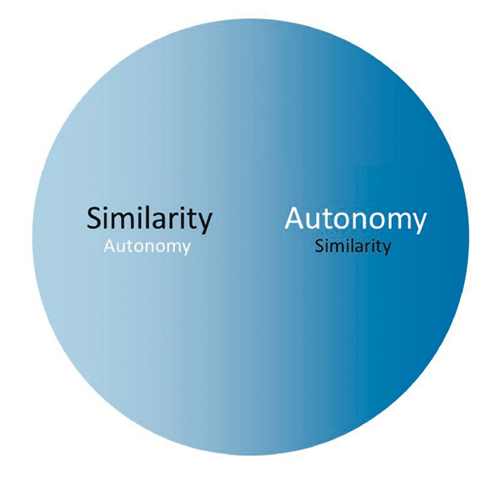
The third part of Dialogue and Valuation, perhaps the most important, since it is where the pre-existing dialogical models are completed, culminates with the epistemological proposal of the axiological hypothesis, based mainly on the complementary dialectical relationship between the concepts of Similarity and Autonomy. Ramirez develops this relationship according to three basic characteristics of interpersonal semantics — semiotic processes, dialogism and emotion — and six fundamental semiotic features of the interlocutors: empathy, conceptualization, knowledge, identity, biology and norms. Each analytical parameter is made explicit within the dialectical scheme Similarity / Autonomy throughout the last chapters, which include the description of a possible diachronic or historical sub-hypothesis, in which the value principles of Similarity and Autonomy are lexicalized as equality and freedom or Liberty, thus adopting an overtly political stance hitherto rather absent, if not completely absent, in the vast majority of linguistic studies. Ultimately, the model proposed by Ramírez is both elegant and totalizing, and it will have to be taken into account from now on in any serious study devoted to linguistic evaluation.
Dialogue and Valuation is a dense but clearly written book, and certainly important, if only because it is the first to present a new, more holistic and by far more convincing view of dialogical appraisal. The author demonstrates an indisputable erudition, both in philosophy and in linguistics and semiotics, but does not overwhelm the reader, but rather informs him in an entertaining and pedagogically sound manner. Anyone interested in the finest processes of human linguistic exchange will find in Dialogue and Valuation many answers to questions that have arisen or will inevitably arise sooner or later.
© UNED & Daniel Ferreras Savoye
Translation by La Vieja Factoría

This work was licensed by SIGNA under a Creative Commons Attribution-Non Commercial 4.0 International (CC BY-NC-ND).
Note: Dialogue & Valuation has been published both in English and Spanish versions
 Revista Mínima