
[the following text is a chapter from the book
Dialogue & Valuation: the Axiological Hypotheis,
by José M. Ramírez
ACVF editorial]
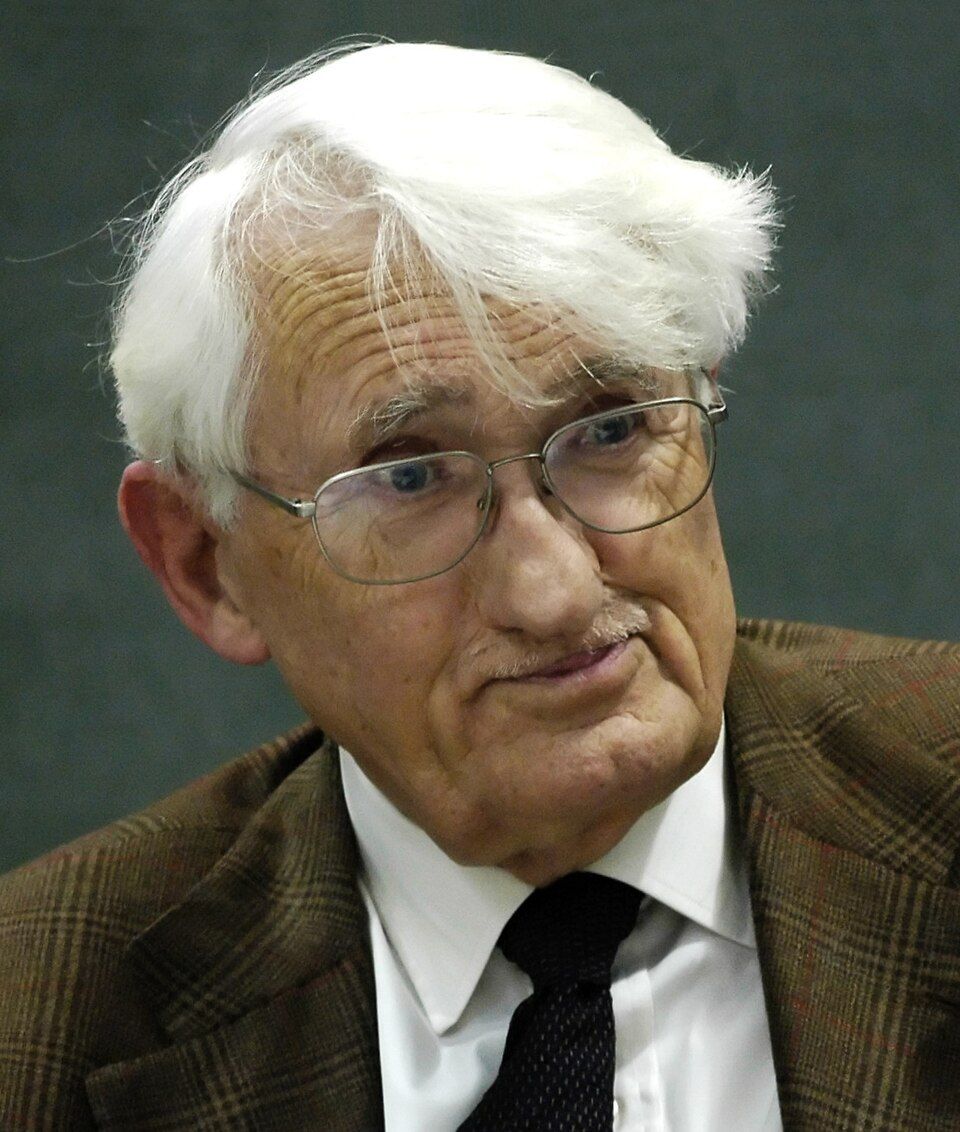
Jürgen Habermas Universal Pragmátics
«It is interests… not ideas, which directly govern people’s actions. However, images of the world, which were made up of ideas, often acted as a switchman that determined the ways in which the dynamics of interests moved action”.
This paragraph is from the essay Economy and Society by Max Weber (1864–1920), and is quoted by Jürgen Habermas in his 1981 work Theory of Communicative Action. We approach the thought of this giant of contemporary philosophy with caution because Habermas’s proposal, which in some respects stands on the shoulders of another giant, Weber, is the ultimate foundation of Van Dijk’s critical perspective on discourse analysis and it is, moreover, the last attempt to construct a universal pragmatics.
Max Weber’s metaphor of the switchman or pointsman reorients the relationship between socio-economic bases and superstructures as defined by Marx and Engels. For Weber, interests drive action, but images of the world—values—can decide the direction of actions. His approach, written in Germany at the beginning of the 20th century, seems to foreshadow what Voloshinov would point out in Russia a few years later: language and its ideas, according to Voloshinov, also exert pressure in the opposite direction on the socio-economic foundations.
A sociologist, Jürgen Habermas (1929) has reflected and written on political philosophy, ethics, and legal theory, although I believe I am not mistaken if we place the philosophy of language at the centre of his thinking. His major work, Theory of Communicative Action, can be broadly defined as a reflection on language and its role in human activities. It is surprising, and a symptom of the fragmentation and self-absorption of current linguistic studies, that his theory has not been contrasted with more recent linguistic developments, although critical discourse analysis does refer to it in its ultimate foundations, and it has inherited its critical orientation from it. In the following pages, we will not go through Habermas’s work exhaustively, but we only comment on a few aspects related to valuation and ideology.
His essay deals with three interrelated themes: the concept of communicative rationality; a concept of society articulated on two levels (lifeworld and system); and a theory of modernity that attempts to explain “social pathologies” as the effects that some systems of action, such as industry, produce by imposing their imperatives on spheres of communicative action, such as political and scientific institutions.
Communicative rationality and social pathologies
Philosophy is, etymologically, the love of knowledge. In practice, it is an activity oriented towards learning, with a vocation for totality and an unfulfilled understanding of the world. However, to the extent that philosophers have become aware of the role that reason itself plays in learning and knowledge, philosophy has become metaphilosophy. For what are “the formal conditions of the rationality of knowledge, linguistic understanding and action”? This is the focus of the approach by Habermas, who defines communicative rationality as follows:
“This concept of communicative rationality has connotations that ultimately go back to the central experience of the uncoerced and consensus-building capacity of argumentative speech in which diverse participants overcome the initial subjectivity of their respective points of view and through a rationally motivated community of convictions secure the unity of the objective world and the intersubjectivity of the context in which they live their lives.”
His concept of communicative rationality can be broken down into the following elements: the aspiration for consensus without coercion, the use of argumentative speech, a surmountable subjectivity, a community of motivated convictions, the unity of the objective world, and the intersubjectivity of the context.
This ideal speech situation, properly an aspirational ideal, should not be confused with an ideology, although it may imply an idealised view of knowledge and language. This concept has left far behind the severe epistemic reductionism of 19th-century positivism, which ignored context and intersubjectivity, did not even consider the existence of the mental and subjective, and in which language itself seemed to play no role. Positivism almost seemed to take for granted an identity between the objective structure of the world and that of language, capable of reflecting it. Language was not questioned. It did not even need to refer to a consensus without coercion, for the truths of science were not disputed. In the positivist model, naïve realism replaced the hard steps of learning, which only several decades later would be reintroduced into science by the pragmatism of Charles Sanders Peirce.
Habermas does recognise learning and the difficulties that lead to knowledge. He explains that “our considerations can be summarised by saying that rationality can be understood as a disposition of subjects capable of language and action”. This disposition includes the possibility of objective judgement and criticism, although controversial validity claims will require “a more demanding form of communication, which satisfies the presuppositions of argumentation”. For the behaviour necessary for argumentation is rational in a special sense, that of learning from mistakes once they are identified. “The learning processes by which we acquire theoretical knowledge and moral insight, expand and renew our evaluative language, and overcome self-deceptions and difficulties of understanding, they require argumentation.” As we can see, Habermas has already naturally integrated evaluation into his view of language. The ideal speech situation is properly an ideal, a model that tries to orient language in one direction. Although his proposal has been branded as ideological, we must reject this accusation. His model is already dialogical and axiological, not ideological. Habermas already clearly distinguishes dialogue and social group, locates consciousness in intersubjectivity, and observes that our verbal and other actions have the capacity to be oriented towards our images of the world, the values. These values can exert a countervailing force on interests, normalising our arguments and actions, and guiding our behaviour.
Habermas’s philosophy of language considers three spheres of value: epistemic, ethical, and expressive. He also considers three decisive value principles in communicative rationality and argumentation, which correspond to each of the three spheres: propositional truth, normative rightness, and expressive truthfulness.
We summarise Habermas’s model in a visual synthesis. We introduce some changes to the previous models of Saussure and Voloshinov. In Habermas, valuation, following Max Weber, goes from being a merely affective and subjective phenomenon, related to speech, to having a normative capacity. For this reason, we shift valuation and place the three spheres of value at the top of the model, governing it. Where Voloshinov spoke of the entire social situation, following Edmund Husserl, Habermas now speaks of the “lifeworld” (Lebenswelt). Ideology, unlike Voloshinov’s model, no longer involves communicative interaction and its signs. Ideology is situated outside the model of communicative action and depends on the system.
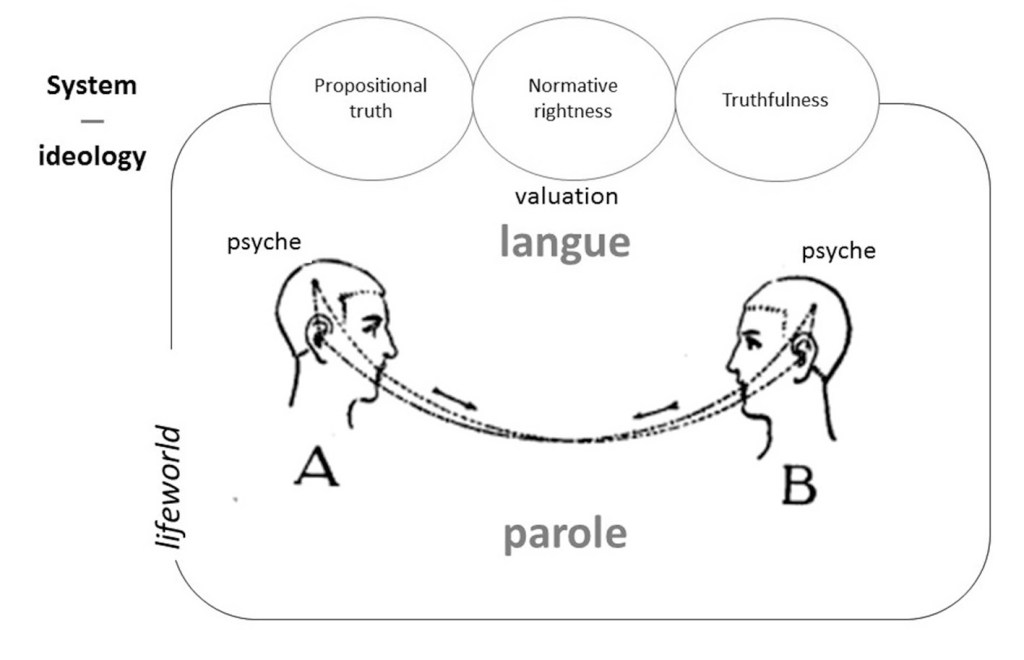
Some preliminary remarks can be made about this axiological model. The first is that it implies the existence of a communicative situation oriented towards understanding, comprehension, and consensus. But in the practical lifeworld, in which we are all immersed, many of our verbal interactions are simply greetings, exchanges of views, and experiences, without reaching a consensus being an end in itself. In conversations, both play and creativity are constant: the allusion, the irony, the joke and the jest, the frustrated courtship, the subtle rejection, the more or less daring or conventional comment, the condescending criticism and judgement, the information that is questioned and discussed, the hint or innuendo, and the strategic compliment. Habermas’s model seems better suited to an academic discussion or an ideal parliamentary debate than to most people’s everyday conversations. Habermas’s model, therefore, does not seem applicable to every communicative situation or every scenario. It also seems to bind intention and limit its capacity to transform representation.
Irony, which is not truthful, can nevertheless be a strategy oriented towards the search for truth. A small subterfuge can also be useful in the communication of an investigation. In his 1888 article, Ramón y Cajal begins by declaring that he does not intend to resolve the question of the connections between nerve cells. “We have no pretensions to solve these problems,” he writes. In this way, he can continue to advance his arguments, his description of the methodology, and his observations. He thus overcomes the initial reluctance of his reticularist interlocutors, although a few paragraphs later, he inevitably comes to the question and enters decisively into it. He then reiterates that in the preparations observed, there are no anastomoses, “never networks”, and, ignoring his initial commitment, he finally proposes the hypothesis of the mediated connection between cells, the basis of the neuronal doctrine.
The second observation, directly related to the previous one, is that Habermas, by prioritising understanding over production, neglects phenomena such as generation, creativity, and imagination itself. Voloshinov has already observed that valuation plays a creative role in language, but Habermas neglects this aspect. By confining expression to truthfulness, he makes verbal production dependent on propositional truth and normative rightness. In a sense, Habermas’s three spheres of value depend on the same principle of value, Truth, which, while embracing its own epistemic sphere, puts at its service the other two: expression understood as truthfulness and normative rightness understood as intellectual honesty. But what happens when the interlocutors do not share the same ethical criteria on an issue? The philosopher Isabel Gamero has called this problem the “Habermas paradox”, since his model of communication is inoperative in current political debates in which consensus is unfeasible, such as those related to euthanasia. Nor is imagination taken into account by Habermas. We have already explained that the same linguistic value evokes different images in the minds of the interlocutors. Verbal communication is made possible to a large extent by the marvellous suggestive power of language, by the images that a combination of words awakens. The speaker reduces his experience, let us say encodes it, and the listener recreates in his mind an experience that may resemble the original in its most relevant aspects. There is an extreme case. Literature is an exercise in imagination with two main actors: the writer and the reader.
However, by limiting expression to truthfulness, Habermas excludes emotion and feeling from his model. His model includes only three spheres, although Martin and White’s appraisal theory intuits four. In addition to epistemic evaluations, which appraisal theory does not study, and ethical evaluations, he divides Habermas’s expressive sphere into two: aesthetics, or appreciations of objects through the senses, and affect, or verbalisation of emotional reactions and feelings. An example of an aesthetic appreciation is the following sentence by Ramón y Cajal, in his scientific article: “These cells are characterised by the elegance of the arborisation of the nervous extensión.” An example of affective appreciation is this one, in his memoirs: “And the year 1888 arrived, my peak year, my year of fortune.” It is the year in which the scientist made the discoveries so eagerly sought after, a year that “rises in my memory with dawning raptures”.
Can we not feel Ramón y Cajal’s state of mind, his happiness at having achieved the ends of so much effort and work? Habermas explicitly rejects the idea that empathy plays a role in communication. In contrast to the philosophers who had already pointed to empathy between interlocutors as a necessary emotion for understanding, Habermas describes it as “the mysterious act of entering into the mental states of a foreign subject”.
This is a key issue. Today, we distinguish three types of empathy: cognitive, related to ideas and beliefs; affective, related to feelings; and compassionate, related to our actions.
We do not know the deep physiological mechanism by which one person can intuit the mental states of another. The notion of a mirror neuron has been proposed, and there is a debate in neuroscience between those who argue that it is a type of neuron specifically designed for this purpose, and those who argue that it is a function by which the neurons of one individual mimic the actions, manners, and perhaps even the thoughts of another individual. In any case, the existence of a mirror neuron function would explain learning by imitation. Does this mirror function also apply to human cognition and verbal language?
It is obvious that we can represent in our minds the ideas expressed by another person, even if the referents and objects represented are not in the immediate context and are not part of our immediate experience. The conventions of language act as a bridge in communication, but they would be insufficient if a psychic process, on a neural and biological basis, were not also triggered. Our thinking has an organic basis. The philosopher and neurologist Mario Bunge argued that the mind is an emergent property of our organism.
The cognitive phenomenon of communication involves the projection of ideas from one mind onto another. This projection may involve a certain degree of uncertainty, as the idea or belief expressed by our interlocutor may or may not coincide with our own beliefs, experiences, and expectations. If we read the title of the painting Almond Blossom, we can represent an almond tree to ourselves, provided we know the conventions of language, have had previous experience of an almond tree, and do not suffer from neural dysfunction. Van Gogh writes to Teo, his brother, and informs him that he has painted an almond tree, and Teo has a mental representation of the almond tree painted by his brother, even though he does not have the painting in sight. It is such a common process that we do not give it the importance it deserves. However, this cognitive representation, which has a neuronal and biological basis, is verbalised by the interlocutor by introducing the other’s thought into his own, embedding it, as in the hypothetical sentence that Teo addresses to his wife: “I have received a letter from Vincent, who tells me that he has painted an almond tree.” Here, we already represent ideas and beliefs that we attribute to the mental representation of another person. This representation of ideas or representations explicitly attributed to another person is called meta-representation.
It is perhaps clearer if it is expressed in formal language. The basic outline of a meta-representation is:
“[I think/say that] A expresses X”.
This formal scheme can be complicated, as a new actor can be introduced:
“[I think/say that] A expresses that B expresses X”.
In addition, concept X may be an idea or belief that the speaker or writer may or may not share.
This is a common cognitive operation. Without meta-representation, there can be no understanding in verbal language, because in a dialogue we are continually representing to ourselves the representations we attribute to other people. Most humans have the capacity to meta-represent even ideas that we do not share because they are contrary to our own experience, as in the following sentence by Ramón y Cajal: “This phenomenon (…) has not escaped Golgi, who in some way tries to explain it, establishing within the grey matter of the centres, a network of axillary expansions (…) which he calls a diffuse network.” Or in an even simpler and clearer way: “Never a network.” The simple negation of a representation of another that we do not share is a meta-representation, for a negation implies the attribution of the denied thought or perspective to another person, even if it is not mentioned, but only implied. In the example, the people implied are Golgi and the other reticularists. This cognitive ability to represent to ourselves representations that we attribute to others is called the theory of mind, and the cognitive theory that explains it has been given, as in a complicated game of mirrors, the name theory of mind theory. People with autism spectrum disorders have difficulty understanding some types of metarepresentations when they include representations that are different from their ideas, beliefs, or expectations, as in the case of irony.
Cognitive pragmatics and dialogism, linguistic theories that are currently far apart, converge in this phenomenon. So does appraisal theory, which categorises heteroglossic resources in the domain of Engagement. Cognitive metarepresentations, in effect, are verbalised as heteroglossic resources in which a speaker or writer embeds the voice or perspective of others in his or her text. “Never a net” remains a simple and paradigmatic example.
Second, we can meta-represent ideas that have not even been verbalised by our interlocutor, as in the following fragment, written by Ramón y Cajal in his memoirs to contextualise his research in the winter of 1888. It is a period of work and renunciation, when everything was yet to be discovered. Ramón y Cajal pursued his research in his spare time, in his own home, and personally bore the costs.
“Faced with that devastating spate of expenses, my poor wife, busy with the upbringing and supervision of five little devils (during the first year of my stay in Barcelona another son was born to me), decided to do without a maid. No doubt she guessed, in my brain, the gestation of something unusual and decisive for the future of the family, and she discreetly and self-sacrificingly avoided any hint of rivalry and competition between the children of the flesh and the creatures of the spirit”.
The fragment offers us an intimate picture of a typically patriarchal middle-income family at the end of the 19th century, characterised by the social, economic, and legal subordination of the wife to the husband. The paid activity of the husband, Ramón y Cajal, a professor in Barcelona, took place in the public sphere, while the wife was in charge of the domestic sphere, in which she made autonomous decisions. Ramón y Cajal now devotes private time and resources to research.
But let us highlight the sentence: “No doubt she guessed, in my brain…”
We can understand Ramón y Cajal’s attribution to his wife as a hypothesis that he makes himself—a hypothesis about a mental state, a hypothesis that he accepts insofar as his wife’s gestures and actions are congruent with it. In other words, Ramón y Cajal metarepresents the non-verbalised mental state of his wife, but materialised in gestures and actions. In turn, his wife has meta-represented her husband’s state of mind, a state not verbalised either, but materialised in gestures and actions: long sessions behind closed doors in the domestic laboratory, the concentrated countenance while observing histological preparations through the microscope. Both metarepresentations coincide and express, about the couple, a bond that is at the same time cognitive, affective, and active. Ideas, feelings, and actions are pieces of the same language puzzle. In our conversations, we constantly, unconsciously, make hypotheses about our interlocutor’s words, and we look for clues in gestures and actions that allow us to validate them.
In the above excerpt from Ramón y Cajal’s memoirs, we see that, even if we understand it as a feeling, empathy fulfils a communicative function: “…my poor wife, busy…” It is a familiar picture full of affection. Let us recall the free indirect style of the writer Anton Chekhov, who puts himself in the shoes of a character and expresses the feelings of others as his own feelings: “resulting in an absurd, dissolute, anodyne existence, from which it was impossible to escape; as if he were a prisoner in a lunatic asylum or in a correctional institution”.
Although we still do not know the physiological mechanism of empathy that connects the interlocutors, it is a phenomenon observed in linguistic analyses, as we have seen. It is also observed in neurological analyses. The distinction between cognitive, affective, and compassionate empathy has been found in experiments that observe the activation of different neuronal groups. In practice, however, they are often joint, interrelated phenomena. To begin with, it was observed that if a person witnessed the pain of another person, pain-related neuron clusters were activated in that person. The suffering of others may cause us suffering, but we can also enjoy the happiness of others. Compassionate empathy differs from affective empathy in that there is an inclination to help, to act and cooperate, in accordance with an elementary sociability. This difference has also been noted at the neural level. Cognitive empathy, finally, basically consists of taking on the perspective of another. This is the phenomenon specifically studied by the theory of mind theory. It involves abstract cognitive operations, and here, too, distinct neuronal groups are activated. This neural phenomenon underlies communicative rationality itself. In all three types of empathy, the interaction with the interlocutor is decisive. Empathy isa dialogical and evaluative phenomenon, at the same time social and cognitive, on a psychic and biological basis.
Lifeworld and system
Marx and Engels distinguished between structures and superstructures in society. The superstructures, consisting of laws, religion, culture, etcetera, would be determined by economic structures. This is a seductive model with an apparent ability to explain historical evolution by measurable forces.
In contrast to Marx’s historical materialism, which seeks to explain the historical process of social rationalisation as a mere product of productive forces, Max Weber sees institutions and the modern state as subsystems of rational action according to ends, meaning values. Recall the metaphor of the train and the switchman. The train is the interest that drives the movement of the world, while the course is decided by the switchman according to values. Weber warns, however, that state bureaucracy can also exert pressure on social relations, stifling them. In fact, he predicted that a mechanistic bureaucratisation project, which, without procedural values, would seek to extend to the last human activity, could reify the lifeworld. This process, inspired by historical materialism, was unleashed in Russia in 1917 with the establishment of the communist dictatorship. For not very different reasons, a fascist regime can also be explained as a reification of the lifeworld, crushed by a state that, using the forces of rebellion to strengthen its own mechanisms of repression, protects oppressive social structures and reaches into the realms of intimacy and conscience. While the ends were different in both systems, social revolution in one case, and social reaction in the other, the means used were similar. The result in both cases was totalitarian cultural, political, and social systems.
However, in the previous paragraph, we have introduced the term lifeworld without defining it. In the visual synthesis of Habermas’s communicative model, we have placed dialogical interaction within the lifeworld, while outside the lifeworld, but surrounding and influencing it, we have placed the social system and ideology.
The concept of lifeworld, Lebenswelt in German, is due to Edmund Husserl, and it is a cornerstone of phenomenology. It is one of those abstract and suggestive notions that populate philosophy and whose mere mention invites us to think. Not only is it a concept of complex definition, but its conceptual force is perhaps based on the fact that it escapes a clear definition. Habermas redefined it over the years. An attempt has been made to explain this by means of the metaphor horizon. The lifeworld would thus be the horizon of the interlocutors, all that space in which all those elements that allow us to communicate and relate to each other fit—a horizon that we cannot reach, but that we can always widen a little more, or restrict.
The science of language can contribute to making this concept more comprehensible. All the phenomena that we have so far pointed out as necessary for communication are found within the lifeworld. In the visual summary of this chapter, we have depicted the lifeworld as a framework. Within this framework fit valuation and values, language, our psyche, personal experiences, culture, etcetera. Any sign, any action, past, present, or future, unfolds in a changing lifeworld with flexible boundaries.
Cultural, economic, and social organisations, and the very institutions that make up the state, are strictly speaking situated within the lifeworld, as they are part of our horizon. However, insofar as they are structures that influence the actors of communication, in coherence with Habermas’s approach and for methodological reasons, we represent them provisionally outside the lifeworld. These organisations and state institutions constitute the social system.
Thus, Habermas’s model, while placing communicative action, the very heart of the lifeworld, at the centre of attention, subsumes the social system. On the epistemic level, we can say that Habermas’s model subsumes linguistics and semiotics in sociology. It is a perspective that the philosopher explicitly defends from the outset, because “within the social sciences, it is sociology that best connects in its basic concepts with the problem of rationality”.
His statement is valid in the scientific context of the period in which he developed the theory of communicative action. Habermas relied on the linguistic pragmatics of Austin and Searle, whose models of language were suggestive, but which could hardly be linked to the social phenomena that affect the linguistic phenomenon and where cognition had not yet been explored. On the one hand, in recent decades there have been enormous developments in cognitive pragmatics and linguistics, syntax, psycholinguistics, and sociolinguistics, as well as in semiotics, in the analysis of languages such as visual, musical, multimedia, technology, or urbanism.
On the other hand, systemic functional linguistics has developed, which, by situating language in its context, has the potential to incorporate all the other currents of linguistics and semiotics on the basis of rigorous textual analysis. In recent decades, the landscape of linguistics has been completely transformed. It is a broken landscape, fragmented into multiple specialisms, which no single linguist can master, in the hope that the pieces of the puzzle can be fitted together into a broader and more coherent vision. One of these pieces may be, in my opinion, Van Dijk’s critical discourse analysis, which to our knowledge is the only current that has so far attempted to combine the cognitive and the social at the same time in a systematic way, based precisely on Habermas’s proposal.
So, indirectly, the model that Habermas offered some forty years ago can enrich the debate that is now shaking the foundations of linguistics and, with it, the social sciences, because we think that the analysis of rationality must be situated at the same time in the psychic and in the social, but resting on the phenomenon in which both aspects interact and materialise, which is language itself in its broadest sense, as semiosis. Reason is not sociological, although it has a social dimension, nor is it psychological, although it has a psychic dimension. We think that reason is language and semiosis and that rationality is linguistic and semiotic.
Max Weber’s sociology, absorbed by Habermas, offers a fascinating idea that can easily be incorporated into linguistic and semiotic studies: the observation that values materialise. If it is true that an image or idea of the world serves as a switchman, this value, by guiding the movement of the train, materialises in a journey. In their most basic aspect, values are materialised in our verbal productions: what we say and what we write is axiologically oriented. Values also materialise in our artistic products: painting, photography, sculpture, and music. Logically, values, by giving a direction to physical, economic, and social forces, materialise in all other cultural products, from technology to urban planning. As the semiologist Umberto Eco argued, any phenomenon of culture can be analysed as an artifice that signifies, and this is so because the phenomena of culture are also the result of a valuational process.
Thus Max Weber argues that the structures of the system are materialisations of ideas, of images of the world. His essay famously attributes the rise of capitalist enterprise to the Protestant ethic. In Habermas’s words, “The Protestant ethic satisfies the necessary conditions for the emergence of a motivational basis for purposeful rational action in the sphere of social labor.” In other words, there is a prior need or interest that is activated in the sphere of social work, but which, thanks to Protestantism, gives rise to the birth and consolidation of a new form of enterprise, the capitalist one. However, Habermas, following Weber, warns that although Protestantism set capitalism in motion, it could not “guarantee the conditions of its own stability as an ethic”. In the long run, capitalism replaced the Protestant ethic with mere utilitarianism. Capitalism, emancipated from ethics, would become a blind force.
We can find many historical and current examples of this materialisation mechanism. A commercial enterprise is originally driven by necessity and interest, but values can guide it. An ancient ship transporting slaves from Thrace to Rome and another transporting amphorae with oil from Hispania were not comparable axiological realities, although the desire to get rich also drove both of them. As in ancient Rome, modern states, by means of laws, establish which means and which ends are possible. From Max Weber’s and Habermas’s proposals, then, an axiological theory of law can be derived.
We leave our reading here for the moment. Even if our foray into the sociology of Weber and Habermas is just a distracted stroll, it is enough to glimpse the enormous wealth of knowledge and proposals that can be obtained from them. We must now return to linguistics, recovering the textual ground of the phenomenon of language. We are going to move from a speculative philosophy, wrapped in a sociology, to a textual analysis that follows a scientific, revisable, and improvable method.
As we can see in the results of our analysis, Habermas’s axiological model is incomplete. It is biased towards the epistemic sphere of value and undervalues the role played in communication by cognitive and social phenomena such as affect, imagination, and creativity, among others. It gives a fair role to comprehension but neglects production. Understanding and production are facets of the same semiotic phenomenon. We move from a model of communicative action to a model of semiotic interaction. Interaction because every question implies a possible answer, and every answer its question. Semiotic because verbal language is only a part, albeit a very relevant part, of signification. The arts and technology also signify. Thus, we highlight the need to incorporate other semiotic languages into the analysis. And we can observe that there are more spheres of value than the three classic ones envisaged by Habermas.
Among them, perhaps a very relevant one that can link the interlocutors is a dialogical sphere. This dialogical sphere, based on the more general characteristics of semiosis and interlocutors, harbours a plural world of values. We then move from universal pragmatics, oriented towards an ideal speech situation and the achievement of a consensus, to a possible humanistic pragmatics, open to a diverse world. This dialogical sphere, if accepted, could be a useful tool in linguistic and semiotic analyses, since we believe that in all human semiotic interaction we are involved human beings, with our virtues and defects, our limitations, and our excesses. We have not yet found any argument or reason that would encourage us to give up this belief.
@ 2024, José M. Ramírez
 Revista Mínima